
UV Printing Troubleshooting: Questions and Answers
6.Simple questions about UV ink

| No. | Question | Answer | Related pages |
| 1 | What is UV? | UV refers to ultraviolet rays, which generally ranges from 200 nm to 400 nm. UV inks absorb UV light of 250-400nm and react and cure.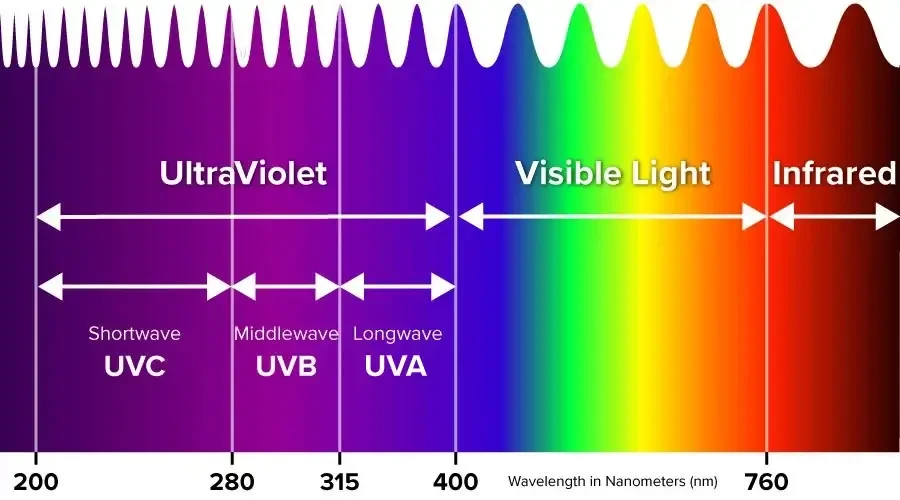 |
|
| 2 | What is the difference between UV ink and oil-based ink? | UV inks harden through a reaction to UV energy, while oil-based inks harden through exposure to oxygen via oxidative polymerization. The table below outlines the general compositions of these inks.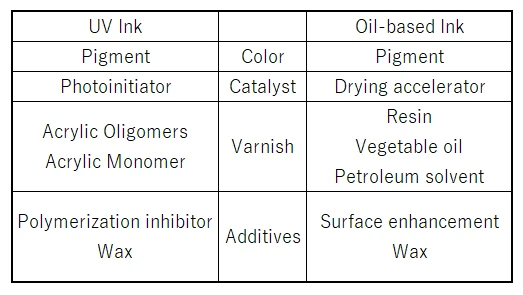 |
|
| 3 | How UV inks get harden? | The photoinitiator in the UV ink, upon receiving UV energy, begins to react. This reaction causes monomers and oligomers to bond consecutively, resulting in the formation of a strong, durable film. | |
| 4 | What are the effects of ultraviolet rays on the human body? | Same as sunlight, excessive exposure to ultraviolet rays can be harmful to the body. However, UV lamps in printing presses are adequately shielded to prevent any light leakage. The bluish-white light that may leak from the delivery system has a wavelength similar to that of visible light and therefore does not pose a risk to the body. | |
| 5 | Is it safe to touch UV ink with your hands? | This is not limited to UV ink, but please be careful not to touch ink directly. Please wear gloves when working. If it comes into contact with your skin, we recommend that you immediately wash it off with water and have medical attention if necessary. Please be sure to read the SDS before use. | |
| 6 | What are the characteristics of UV ink? | Most notable feature is its ability to cure instantly upon exposure to ultraviolet rays. Additional advantages are such as non-VOC and durable hard film. | |
| 7 | What are the disadvantages of UV inks? | Since it cures instantly, the ink surface does not undergo leveling, making it more challenging to achieve gloss compared to oil-based inks. Additionally, UV printing presents other unique challenges. For further details, please refer the “UV Printing Troubleshooting” guide. | |
| 8 | Does UV printing require special materials? | To optimize the use of UV inks, it is essential to use materials specifically designed for UV printing, which differ from those used for oil-based inks. For detailed guidance, please contact our sales representative or the manufacturer of your printing machine. Recommended materials such as roller washing agent, plate cleaner, rollers, blankets, compatible those with UV inks, (it is crucial to select a blanket that matches the specific ink type and printing conditions). Additionally, cleaning clothes, UV-compatible plate. | |
| 9 | Is an exhaust duct required for UV printing? | Ozone is generated at wavelengths below 250nm, which can be harmful to health and accelerate the oxidation of iron. Therefore, it must be forcibly vented. UV lamps that do not produce wavelengths below 250nm, such as ozone-less UV lamps and LED-UV lamps, do not require exhaust ducts. | |
| 10 | What is adhesion? | On non-absorbent papers, foil papers, and plastic substrates, ink adhesion can be challenging, and it may easily peel off with tape. It is essential to choose ink that is compatible with the printing substrate and to verify adhesion both during printing and throughout product use. | Refer to Troubleshooting Adhesion failure |
| 11 | What is the source of the odor in UV inks and UV-printed materials? | The odor in inks is primarily caused by the presence of monomers and photoinitiators. For printed materials, the smell of decomposition products, including monomers and photoinitiators, may persist if curing is incomplete. However, once the material is fully cured, the odor diminishes, which is reason why UV inks are also suitable for use in food packaging and cosmetic packaging. | |
| 12 | What is nitrogen replacement? | Oxygen inhibits the UV ink curing process, but injecting nitrogen into the lamp house accelerates curing by eliminating oxygen. This, along with minimal initiator use, results in low odor. | |
| 13 | What is swelling? | This phenomenon occurs when the rollers and blanket are incompatible with the ink and washing agent, causing them to swell, altering nip pressure. This can affect ink kneading on rollers and transfer patterns between jobs. It is recommended to use materials resistant to swelling. | Refer to Troubleshooting Printing Defects 417 |
| 14 | What fields are unsuitable for UV printing? | There is no field for which it is particularly unsuitable. However, since they are used in a variety of applications, it is important to conduct preliminary confirmation tests in accordance with actual usage conditions. | |
| 15 | Is UV printing safe to use for food packaging? | UV printing can be used on food packaging, but like most printing inks (except for some specialized types), direct contact between the ink surface and the food must be avoided. Measures such as using an inner bag or laminating the ink surface should be implemented. When printing on food packaging, ensure the ink does not come into direct contact with the food. | |
| 16 | Is CMS for UV printing difficult? | Compared to oil-based inks, UV inks have inferior wet trapping, tendency for dot gain. Thus, it is recommended to use the most suitable blanket and create profiles specifically for UV inks. | |
| 17 | Is it true that UV inks emulsify easily? | Due to the resin characteristics, UV inks have a narrower water tolerance than oil-based inks and are more prone to emulsification. In particular, inks for non-absorbent papers tend to emulsify more on the latter unit due to excess water. It is recommended to use the dampening water as less as possible. | |
| 18 | Why does UV ink become hard in winter? | Due to their composition and design, UV inks are more sensitive to temperature fluctuations than oil-based inks, becoming harder and less fluid as the temperature decreases. In winter, it is recommended to warm up the printing press and keep several kilograms of ink warm for use or use a heater to maintain the optimal ink temperature. | |
| 19 | Does UV gold and silver have poor color development? | Historically, the coloring of gold and silver in UV inks was inadequate. However, our company’s UV Gold and UV Silver now deliver colors comparable to those of oil-based inks. | Refer to our Ink products |
| 20 | Is it possible to do waterless printing in UV | Same as oil-based inks, UV inks are also available for waterless printing offered for paper, film. | Refer to our Ink products Waterless UV |
| 21 | How can we achieve environmentally friendly by UV printing? | UV inks are generally non-VOC with some exceptions, allowing the "VOC Free" printing. Additionally, we launch Environmentally UV products by adding in ingredients of biomass materials. | Refer to our Ink products Biomass Mark Certified UV Ink |
| 22 | What is pseudo-embossing (Drip-off effect)? | Use both repellent varnish and coating varnish together. By printing underlying layer by repellent varnish and applying a coat varnish over it, the areas with varnish on the base layer become rough, creating a glossy appearance that contrasts with the areas without varnish. | Refer to our Ink productsUV repellent varnish UV coat varnish |
| 23 | How can we check the adhesion of UV inks? | Use a 15mm wide tape. To basic test adhesion, press the tape firmly onto the ink surface with your finger and pull it off quickly at a 45-degree angle. For stricter test, make 11 vertical and horizontal cuts at 1mm intervals in the ink film using a cutter knife, then peel the tape off using the same method. If the printed material may get wet or be refrigerated/frozen, immerse it in water for several hours, briefly wipe it dry, and then peel off the tape before it dries (water-resistant adhesion test). | |
| 24 | Why do UV inks for non-absorbent substrates cure insufficiently? | For film applications, the design prioritizes adhesion. However, materials used in UV inks present conflicting properties regarding adhesion and curing. Inks with better adhesion tend to less curing than those designed for general-purpose paper. | |
| 25 | How to distinguish the use of Reducers and Contex. | Reducer: A viscosity adjuster that lowers tack (viscosity) and enhances flow. It is typically used to improve ink application, especially when a better flow is needed. Contex: A viscosity adjuster that also lowers tack (viscosity) but does not significantly affect flow.Excessive addition may lead to both failure of curing and adhesion. The maximum recommended addition is 5%. Those depends on ink type, so please contact our sales representative for specific recommendations. |
Refer to Troubleshooting Curing failure 106 |
| 26 | Are there UV inks with less odor? | We offer a wide range of products. Please contact our sales representative for more information. While UV inks have less odor than oil-based inks, the odor is distinct, and some individuals may find it more noticeable. | |
| 27 | Catalog of UV inks and was surprised at the variety. | Due to the wide range of applications for UV inks, various types are required to match different printing methods, conditions, substrates, post-processing techniques, and usage scenarios. When selecting the appropriate ink type, please consult our sales representative for guidance. | |
| 28 | Is there a density difference compared to oil-based ink? | UV ink process colors are formulated to achieve a density similar to the oil-based inks. However, due to differences in drying(curing) methods, the gloss surface may look different. | |
| 29 | Is wide color gamut printing possible with UV inks? | It is possible and please contact our sales representative. | |
| 30 | Can UV printing be done without alcohol? | It is possible, but the fountain solution must be chosen to match the water supply mechanism of the printing press. Emulsification is a concern in film printing, so extra caution is needed. Please contact our sales representative for further details. | |
| 31 | Can print oil-based OP varnish be over UV ink? | Depending on the type of UV ink used as the underlying, may only be possible offline printing. The UV ink film remains in a film-like state, making it difficult for oil-based inks to set and dry. Therefore, caution is needed when selecting the OP varnish and determining the amount of powder. | |
| 32 | Is it possible to print with oil-based inks and UV inks at the same time? | Theoretically, it is possible if the oil-based ink and UV ink designs do not overlap on the images. However, since UV irradiation and powder spraying are performed at the same time, this can negatively affect the UV lamp, so we do not recommend it. If the designs overlap, the UV ink will not adhere, whether offline or inline. As a solution, we offer a range of dedicated UV OP varnishes that can be applied over oil-based inks to counteract the effects of powder. | |
| 33 | Why reverse trapping is more likely to occur than with oil-based inks? | UV inks have a tack balance that is less likely to cause reverse trapping, taking into consideration their use in processes. However, UV inks are solvent-free and do not set on the paper, so there is no thickening of the ink on the front cylinder, making them more prone to reverse trapping. If reverse trapping cannot be fixed by adjusting the tack with additives, it may be possible to improve the situation by adjusting the cylinder tailoring or blanket. | Refer to Troubleshooting Printing defects 407 |
| 34 | Why are UV inks harder than oil-based inks? | There is no significant difference in tack and viscosity between oil-based ink and UV ink. However, UV inks tend to feel harder to the touch due to their short flow (thixotropic nature) and solvent-free composition. | |
| 35 | Why is gold and silver recommended to be stored in a refrigerator or cool place? | The metallic powder acts as a catalyst for curing, causing the ink to gel more easily than regular inks. For stable storage, it is recommended to store the ink in a cool, dark place (15°C or below) to prevent the reaction. | |
| 36 | What is gelation? | The ink becomes gelation (become solid) and cannot be pierced with a spatula, etc. Gelation of UV ink tends to start from the bottom of the container, even if the container has not been opened. | Refer to Troubleshooting Ink defects 301 |
| 37 | Can we mix it with other maker's UV inks? | Each type of UV ink from different manufacturers uses unique raw materials. Mixing inks of different types can negatively impact physical properties such as curing, adhesion, and overall performance, as well as shortening the pot life. Therefore, it is advised not to mix inks of different types, even from the same manufacturer, let alone from different companies. | |
| 38 | Why do Rhodamine, Purple, Violet, etc. cause bleeding? | Colors such as Rhodamine, Purple, Violet, and those brighter tones and often use fanal pigments, which have poor solvent resistance and are prone to bleeding and discoloration. It is recommended to review post-processing and usage conditions or opt for inks with stronger resistance, even if they are slightly less saturated or brighter. For resistance information, please refer to the resistance table or contact our sales representative. | Refer to Troubleshooting Printing defects 510 |